
You Already Use AI. Here's Where It Actually Belongs in Your Freelance Business.
You've used Claude or ChatGPT. And you've probably had both reactions to it: the hour it saved you, and the moment it handed back something so generic you rewrote the whole thing from scratch.
The problem usually isn't the model, and it isn't your prompting. It's that you're aiming AI at the wrong part of your business. Your workflow is the product, and AI earns its keep on the operational work around the craft, not on the craft itself.
The workflow you already run (but probably never mapped)
Ask a freelancer what they sell and they'll point at the deliverable. But clients experience something bigger: they experience your whole workflow. And odds are you've never actually put it on paper:
Find → Pitch → Lock in → Do the work → Deliver → Get paid → Follow up.
That loop runs on every project you take. Notice how little of it is the craft. One step, do the work, is the thing you trained for. The other six are the business:
scoping and proposals
contracts and revisions
invoicing and chasing payment
Each is small. Together, they're a tax you pay on every single project, and it's where your time quietly goes. In freelancermap's 2025 freelancer survey, 43% of respondents said they spend roughly 10 to 20% of their working time, about five hours a week, on unproductive, non-billable tasks like client accounting. Add that up over a year and it's the better part of 250 hours, more than six standard work weeks, spent on business admin instead of billable craft.
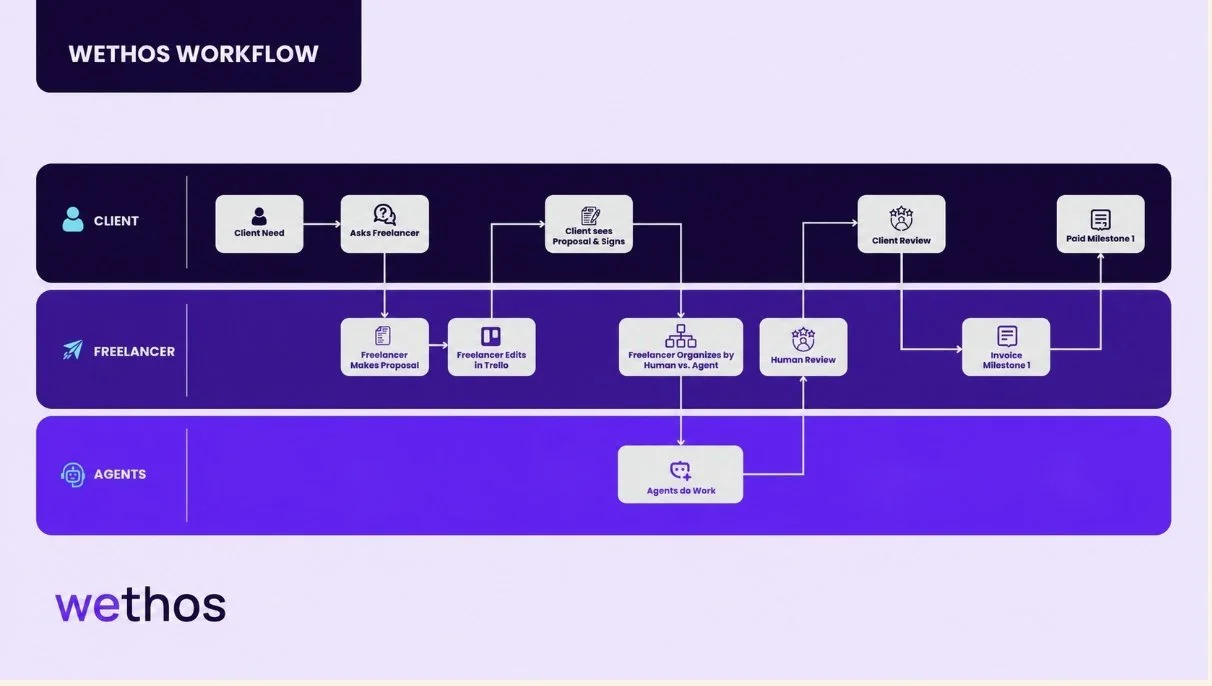
Freelancer workflow with AI
Craft vs. operations: where your AI is wasted vs. where it pays
Here's the mistake almost everyone makes when they first reach for AI: they point it at the craft. The copywriter has it write the copy. The designer has it generate the concept. The developer has it write the core logic. The output comes back competent, generic, and unmistakably not you, so you either rewrite it or ship something a little worse than your usual work. That's the exact experience that made you skeptical.
But that was AI aimed at the wrong layer. The leverage is on the operational work. The proposal you rewrite from scratch every time, the contract you keep meaning to standardize, and the invoice. That work is repetitive, language-heavy, and rule-based, exactly what AI is good at, and exactly what's draining your week. Re-aiming from the craft to the operations matters more than any new model release or prompt trick.
The part that's actually new: from answering to doing
The version most freelancers formed an opinion on was the chatbot. You ask, it answers, you copy-paste, you do everything else. IBM's own definition captures why that felt limited: a chatbot is software that simulates conversation, it answers what you ask, turn by turn, but it doesn't plan ahead or act on its own. Being underwhelmed by that was reasonable.
What's changing is the move from tools that answer to tools that act. AI agents that can carry a sequence of steps in your workflow rather than just generating a block of text when prompted. That's a different thing. For now, the point is just this: the reason to get your aim right is that the tools aiming at your operations are about to get a lot more capable. The market's already moving there with gross services volume for AI-related work on Upwork grew 60% year over year in 2024, with freelancers out-adopting full-time staff on AI proficiency, 54% versus 38% (Upwork Research Institute, 2025).
Grow without hiring (or burning out)
Here's the bind every busy freelancer eventually hits. Every new client adds more than creative work, it adds another round of proposals, invoices, and follow-ups. So the more you grow, the more of your time disappears into the operational side.
Now AI is doing more work than ever, and so you are able to handle more clients, and tools that help with this busywork become more valuable than ever.
That's the freelancer-specific payoff of integrating with AI in operations. It soaks up the repetitive work that normally piles up with every new client. You can take on more without drowning in busywork, or putting anyone on payroll.
Mapping AI onto the loop
Concretely, here's where it pays off, step by step:
Pitch: draft and tailor proposals from a short brief instead of starting cold every time.
Lock in: generate contracts and onboarding docs from your templates.
Deliver: first drafts, research reports, summaries, and revision notes you then shape with your judgment.
Get paid: invoices and the payment follow-ups you keep putting off.