
New to Freelancing in the Age of AI? Start With Your Workflow
A question stops a lot of people before they ever send their first proposal:
Is freelancing still worth starting when AI can already write, design, and code?
It is a fair concern, but it is also the wrong place to begin.
You're not too late. You're early. More than a quarter of U.S. knowledge workers, over 20 million people, now freelance or work independently, and they collectively earned $1.5 trillion in 2024, according to Upwork's Future Workforce Index (Upwork Research Institute, April 2025). You're joining a large, active market, not a disappearing one. And your head start isn't a secret prompt or mastering every new AI tool. It will come from understanding how freelance work moves from a client’s initial need to a completed project and a paid invoice.
First, the fear: will AI replace freelancers?
AI is already good at producing first drafts, layouts, research summaries, and working code. It can move quickly, and in the right situation, it can save hours.
But producing something is not the same as managing a successful client project.
AI cannot sit with a client and uncover what they need when their brief is unclear. It cannot decide when a request is outside the original scope, explain a difficult recommendation, or become the person a client trusts with an important launch, brand, or business decision.
This isn't wishful thinking. The World Economic Forum's Future of Jobs Report 2025 assessed more than 2,800 individual work skills for how replaceable they are by today's generative AI. Zero were rated as having “very high capacity” to be substituted, and 69% were rated “very low” or “low” capacity. Roles are far more likely to be transformed than eliminated, with human workers shifting toward judgment, creativity, and relationships.
The real divide, then, is not freelancers versus AI. It is freelancers who know how to run their work and use AI selectively. Versus freelancers who do not have a clear process at all.
Understanding AI is important and critical. If you have not yet read our take on “What Is an AI Agent?” then that 5 minute read is worth it, as it will help put the rest of this in context.
What “your workflow” even is
Your workflow is the full path every project travels, from the first message a client sends to the moment you're paid. Whatever your field, it runs the same loop:
Find the client or the opportunity
Pitch it: scope it, price it, send a proposal
Agree: contract, deposit, kickoff
Do the work: the craft, the part you trained for
Deliver: feedback, revisions, sign-off
Get paid: invoice, and chase it when you have to
Follow up: testimonial, referral, repeat business
A clear workflow matters because every part of a project depends on the step before it. When the proposal is vague, the work becomes harder to manage. When responsibilities are unclear, revisions multiply. When invoicing is treated as an afterthought, getting paid becomes more difficult than it needs to be.
That is also why it helps to separate the workflow into three roles:
what the client decides
what the freelancer owns
and what an AI agent can help execute
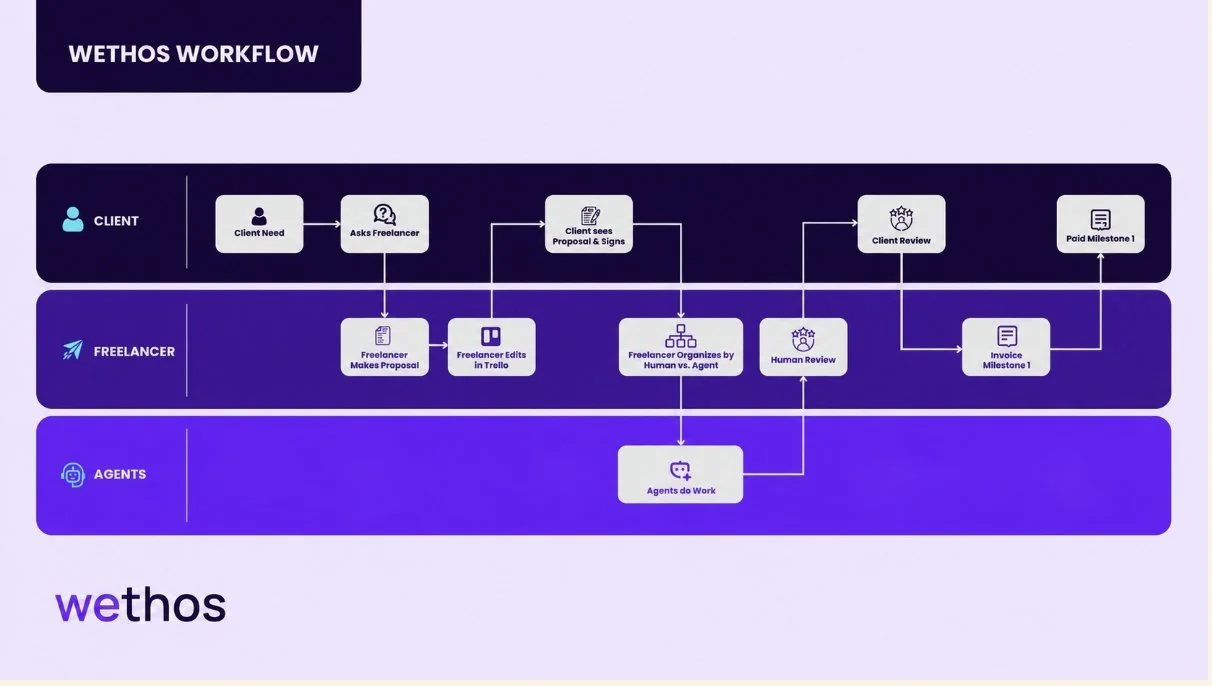
Freelancer and AI workflow.
Where AI actually helps a beginner
AI should not run the entire freelance process. It should enter the workflow only after you understand the project and decide what work can safely be delegated.
The client brings a need. You speak with them, clarify the assignment, and create the proposal. A platform such as Wethos can help you structure that proposal, define the scope, organize the project, and manage milestones and invoicing.
Once the client approves the proposal, you can divide the work into two categories:
Work that requires your judgment, communication, or creative direction
Clearly defined production tasks that an AI agent can assist with
That second category is where AI becomes useful. For example, an agent might:
Gather background information and source material
Build an initial competitor scan
Organize research into a usable format
Create a rough first pass for you to react to
Complete repetitive, well-defined production steps
The important point is that you decide what the agent does. You provide the direction, review the output, correct mistakes, and make the final judgment before anything reaches the client.
What AI won't do (and why that's good news for you)
Be just as honest about the limits. AI won't supply judgment. It won't build the relationship that brings a client back, or earn the kind of trust that turns into a referral.
When you outsource every structural choice, creative decision, or final recommendation, you also skip the practice that helps you improve. AI can accelerate your work, but it should not replace the process of developing your own judgment.
The takeaway
You do not need a complicated AI system to begin freelancing. You need a clear way to move from a client's need to a signed proposal, organized work, an approved deliverable, and a paid milestone.
Once that structure is in place, AI becomes much easier to use well. You can identify the exact tasks an agent should handle, review the results, and keep control of the project from beginning to end.
Wethos gives you the structure to move a project forward. From building the proposal and organizing the work to managing milestones and getting paid. With that foundation in place, you can bring AI into the parts of the project where it saves time, while keeping control of the client relationship and the decisions that matter most.
Build your first proposal today, for free.